
Every recurring payment journey begins the moment a member clicks “Pay.” While the transaction appears simple on the surface, it travels through a complex network of payment gateways, processors, card networks, and issuing banks before an approval or decline is returned. Understanding the recurring payment journey helps organizations improve payment success rates, reduce failed payments, and protect recurring revenue.
For organizations that rely on recurring revenue, understanding this journey isn’t just interesting– it’s essential. It helps explain why payments fail, why some recover automatically, and why payment recovery requires far more than simply retrying a transaction.
Let’s follow the journey.
Step 1: The Payment Is Submitted
Everything begins when a member enters or saves their payment information.
This could happen when they:
- Join a gym
- Renew a membership
- Make a recurring donation
- Subscribe to a service
- Update their card on file
The payment information is securely transmitted to the organizations payment gateway.
At this point, no money has moved.
The transaction is simply beginning its journey.
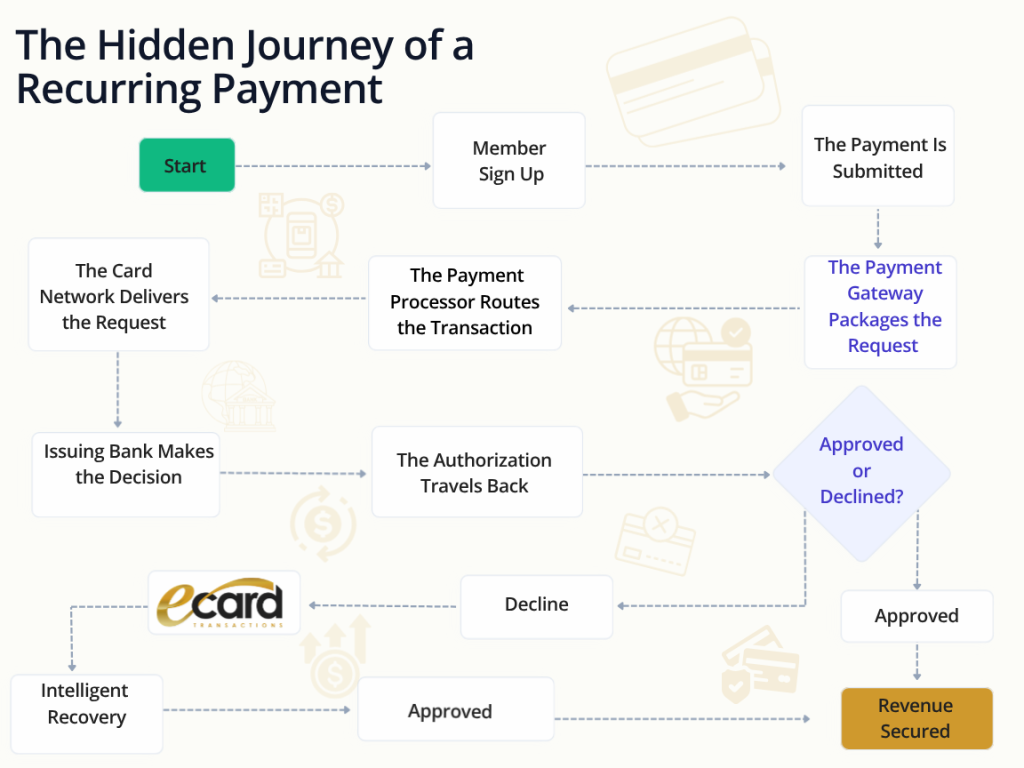
Step 2: The Payment Gateway Packages the Request
Think of the payment gateway as the secure messenger.
Its role is to encrypt payment information, verify required data is present, and securely forward the authorization request to the appropriate payment processor.
Contrary to popular belief, the gateway doesn’t decide whether a payment is approved.
It simply helps move information safely from one system to the next.
Step 3: The Payment Processor Routes the Transaction
The processor receives the authorization request and determines where it needs to go.
Depending on the card being used, the request travels through on of the major card networks before reaching the card holder’s issuing bank.
This entire process typically takes only a few seconds.
Step 4: The Card Network Delivers the Request
Card networks act like traffic controllers.
Their job is to ensure the authorization request reaches the correct issuing bank and that the response returns through the same secure path.
They don’t decide whether the payment is approved–they simply help facilitate the communication.
Step 5: Issuing Bank Makes the Decision
This is where the approval–or decline–actually happens.
The issuing bank evaluates many factors including:
- Available funds
- Card status
- Fraud monitoring
- Spending limits
- Security rules
- Payment credentials
- Merchant information
If everything checks out, the bank authorizes the transaction.
If not, it returns a decline code explaining why the payment wasn’t approved.
Step 6: The Authorization Travels Back
The authorization response travels back through the same secure path.
Within moments, your billing system receives one of two messages:
Approved
or
Declined
For the member, the experience lasted only seconds.
Behind the scenes, multiple organizations worked together to make that decision.
When the Recurring Payment Journey Doesn’t Go as Planned
A declined payment doesn’t always mean something is wrong.
It certainly doesn’t mean the member wants to cancel.
Many declines occur because of routine events, including:
- Expired cards
- Card replacements after fraud
- Temporary insufficient funds
- Updated security settings
- Incorrect payment credentials
- Issuer risk controls
Some issues resolve themselves within days.
Other require updated payment information or communication with the member.
Understanding the reason behind the decline is critical to determining the next step.
Where Recurring Payment Recovery Fits Into the Journey
Payment recovery begins after the authorization process ends.
This is where organizations shift from simply processing payment to intelligently managing payment failures.
Modern recovery strategies may include
- Optimized retry timing
- Updated payment credentials through Account Updater
- Network token technology
- Decline-code-specific workflows
- Automated member communication
- Recovery reporting and analytics
Each tool addresses a different reason why payments fail.
Together, they create a more resilient recurring revenue strategy.
Why Understanding the Journey Matters
However, many organizations think of recurring payments as a single event.
In reality, every transaction passes through an interconnected ecosystem of technology providers, financial institutions, and security systems.
The better organizations understand that ecosystem, the better equipped they are to improve authorization rates, reduce involuntary churn, and create a smoother payment experience for their members.
Recurring payment don’t begin and end with a click.
They begin a journey, and each step along the way can determine whether they collect revenue successfully.
Final Thoughts
The next time someone clicks “Submit Payment,” remember that the transaction is only beginning.
Behind every approved payment is a carefully coordinated network working together in seconds. Behind every declined payment is an opportunity to understand what happened, improve the process, and recover revenue that might otherwise be lost.
Organizations that understand the journey are better positioned to optimize it.
Enjoyed This Article?
Explore more insights on recurring payments, payment recovery, and revenue optimization in the eCard Insights Blog.
- The Ultimate Fix for a 30–40% Recovery Rate
- The Hidden Journey of a Recurring Payment
- Payment Recovery Blueprint: 10 Proven Strategies to Reduce Failed Payments and Protect Recurring Revenue
- The Cost of Platform Lock-In: Why Flexibility Matters in Membership Technology
- The Hidden Cost of a 20% Difference in Payment Recovery