
When evaluating payment and revenue recovery strategies, many organizations focus on processing expenses and operational efficiencies. However, one of the most significant financial opportunities often receives far less attention: payment recovery performance.
Every month, membership organizations experience failed payments due to insufficient funds, expired cards, fraud replacements, lost cards, account closures and other common banking events.
Industry estimates suggest that 8–10% of recurring payments fail each month. The question isn’t whether failed payments occur.
The question is: How much of that revenue gets recovered?
For many organizations, the difference between an average recovery rate and a high-performing recovery strategy can represent tens of thousands of dollars in annual revenue that would otherwise be lost.
A recovery rate of 65% maybe considered strong performance. But what happens when you can recover 75% or even 90%?
The answer can have a significant impact on an organizations financial health, member retention, and long-term sustainability.
Let’s take a look at the numbers.
An Example:
Consider a gym with:
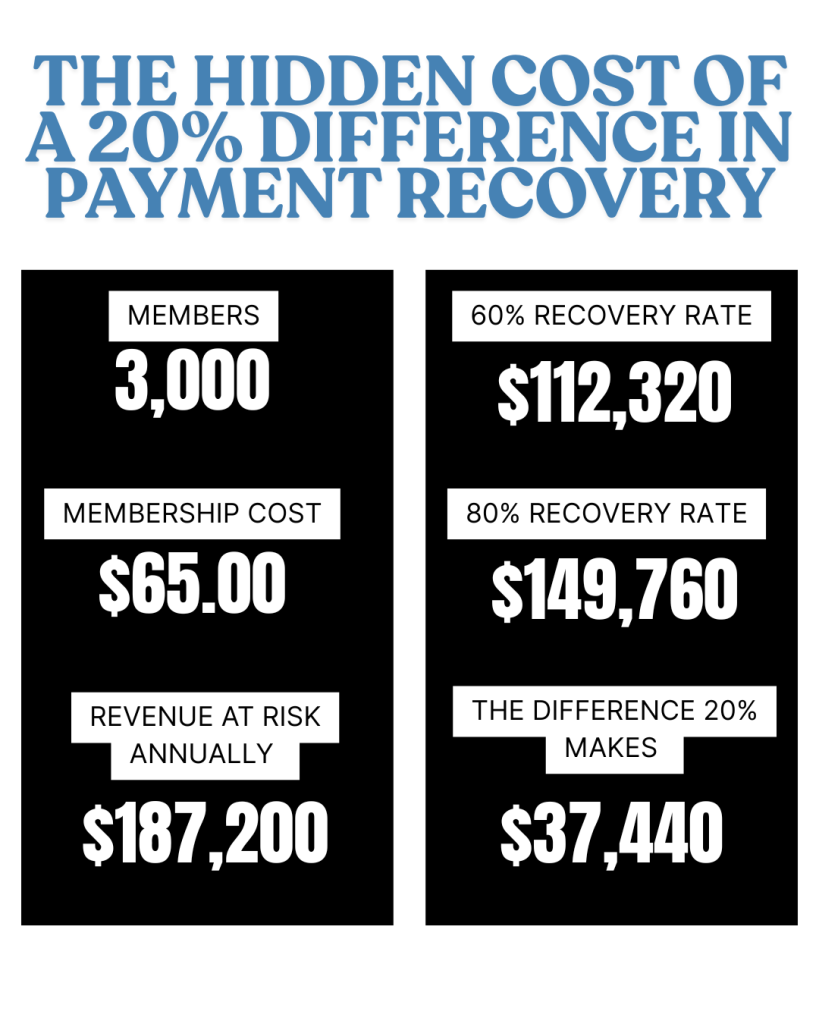
- 3,000 active members
- Average monthly membership dues of $65
- Monthly membership revenue of $195,000
If approximately 8% of recurring payments fail each month, that places:
$15,600 in revenue at risk every month.
or
$187,200 in annual revenue at risk.
Comparing Recovery Performance
| Recovery Strategy | Recovery Rate | Annual Revenue Recovered |
| Traditional In-House Process | 40% | $74,880 |
| Standard Recovery Solution | 65% | $121,680 |
| Strong Recovery Performance | 75% | $140,400 |
| Advanced Recovery Performance | 85% | $159,120 |
| High-Performing Recovery Strategy | 90% | $168,480 |
At first glance, the difference between these recovery rates may not appear dramatic.
However, the financial impact tells a very different story.
Compared to a Traditional In-House Process
Many organizations still rely on staff follow-up, basic billing notifications, or limited retry schedules to recover failed payments.
If that approach recovers only 40% of failed payments, the organization would recover approximately $74,880 annually.
Now compare that to higher-performing recovery strategies:
- 75% recovery generates an additional $65,520 per year
- 85% recovery generates an additional $84,240 per year
- 90% recovery generates an additional $93,600 per year
For many organizations, that’s enough revenue to fund programs, offset operating expenses, invest in facility improvements, or avoid acquiring hundreds of new members simply to replace lost revenue.
Compared to a Standard Recovery Solution
Many payment recovery providers report recovery rates around the 65% range.
For our example gym, a 65% recovery rate would generate approximately $121,680 annually.
While that may seem strong, there is still significant room for improvement.
Compared to a 65% recovery rate:
- 75% recovery generates an additional $18,720 annually
- 85% recovery generates an additional $37,440 annually
- 90% recovery generates an additional $46,800 annually
That represents revenue the organization has already earned but may never collect without the right recovery strategy in place.
Why Recovery Rates Differ
Not all payment recovery systems operate the same way.
Many solutions rely heavily on scheduled retries. When a payment fails, the system simply attempts the transaction again at predetermined intervals.
The challenge is that not every decline should be treated the same.
An expired card requires a different recovery approach than insufficient funds.
A fraud replacement card requires a different strategy than a temporary bank decline.
A closed account requires a different workflow than a simple timing issue.
Treating every failed payment the same can result in:
- Lower Recovery Rates
- Delayed Collections
- Increased Member Churn
- Additional Staff Workload
- Missed Recovery Opportunities
Curious how much revenue may be at risk within your organization? Use our Revenue Recovery Calculator to estimate your potential recovery opportunity.
Beyond Simple Retries
Effective payment recovery is about more than retrying a transaction multiple times.
The most successful recovery strategies combine:
- Intelligent Decline Code Analysis
- Strategic Retry Scheduling
- Account Updater Services
- Real-Time Visibility into Recovery Performance
The goal is not simply to attempt the transaction again.
The goal is to identify why the payment failed and apply the most effective recovery strategy for that specific situation.
Revenue Recovery Is Membership Retention
Every recovered payment represents more than a successful transaction.
It often represents:
- A retained membership
- Continued participation
- Reduced staff intervention
- Improved customer satisfaction
- Increased member lifetime value
For mission-driven organizations, recovering revenue isn’t just about collections. It’s about protecting relationships and preserving the revenue that supports programs, services, and community impact.
The Bottom Line
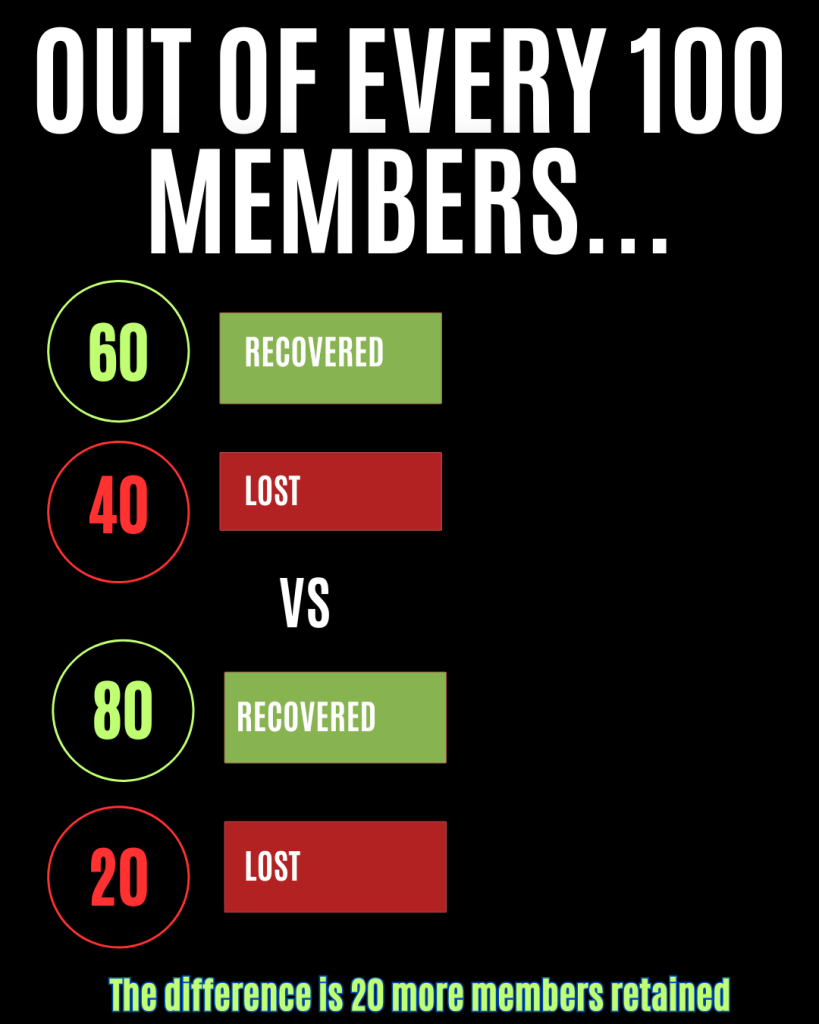
When evaluating payment recovery performance, even a 10% or 20% improvement in recovery rates can translate into tens of thousands of dollars in additional annual revenue.
For the organization in our example the difference between recovering 65% and recovering 85% of failed payments equals $37,440 in additional annual revenue.
The difference between recovering 40% and 90% equals $93,600 annually.
That is revenue the organization has already earned.
The question is whether it gets recovered or not.
Discover how a 20% difference in payment recovery performance can impact annual revenue. Learn why recovery rates matter and how membership organizations can recover more revenue from failed payments.
Talk to a failed payment expert today!
Frequently Asked Questions
What is a good failed payment recovery rate?
While results vary by industry and billing model, many organizations consider recovery rates above 65% strong performance. Advanced recovery strategies may achieve recovery rates of 75% to 90% depending on member engagement, account updater services.
Why do recurring payments fail?
The most common causes include insufficient funds, expired cards, over limit, lost or stolen cards, fraud, account closures and issuer declines.
How do payment recovery services improve recovery rates?
Modern recovery strategies combine intelligent retry scheduling, account updater services, decline-code analysis and member communication to improve recovery outcomes. Combining AI and machine learning with years of data delivers the highest rates.
How much revenue is typically at risk from failed payments?
Industry estimates suggest that 8-10% of recurring payments fail each month, creating significant revenue risk for membership organizations, nonprofits, and subscription-based businesses.
Other Related Blogs:
The future is intelligent, proactive, and relationship-focused because: Payment Recovery Is Becoming A Customer Experience Strategy
Check out: The Ultimate Guide to Failed Payments