
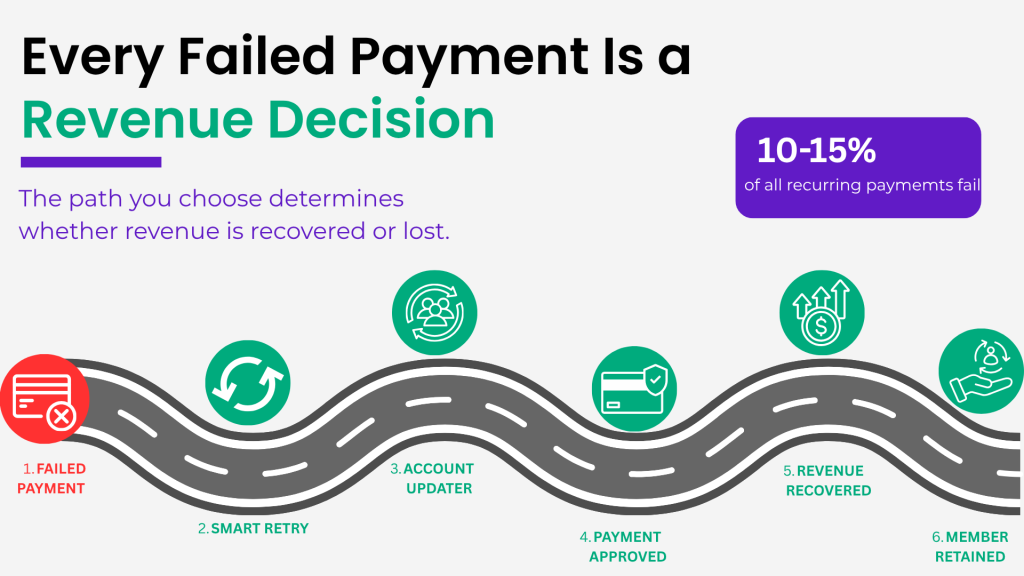
Every Failed Payment Is a Revenue Decision
Payment recovery is one of the most effective ways recurring revenue businesses can protect revenue and reduce involuntary churn. While organizations invest significant time and resources acquiring new customers, but many overlook one of the largest opportunities for growth: recovering payments that were never meant to fail.
Effective payment recovery has become one of the most important strategies for protecting recurring revenue. While organizations invest heavily in acquiring new customers, many overlook revenue that can be recovered after a payment fails.
Credit cards expire. Banks issue replacement cards. Temporary insufficient funds occur. Fraud prevention systems replace account numbers. None of these situations necessarily indicate that a customer wants to leave.
The businesses that consistently outperform their competitors don’t simply process payments-they build systems designed to recover them.
Over the past two decades, payment technology has evolved from simple retry schedules into intelligent recovery strategies powered by data, automation, and continuous optimization.
Here are ten proven strategies every recurring billing organization should implement to maximize revenue recovery.
Strategy 1: Separate Temporary Payment Failures from Permanent Ones
One of the most common mistakes organizations make is treating every declined payment the same.
Not every failed transaction represents a lost customer.
Some declines are temporary, while others require customer action before another payment attempt should be made.
Understanding the difference allows businesses to focus recovery efforts where they have the greatest chance of success instead of wasting authorization attempts on transactions that are unlikely to recover.
Strategy 2: Build Your Payment Recovery Strategy Around Data
However, many businesses still rely on fixed retry schedules.
For example:
- Retry every two days
- Retry three times
- Stop after seven days
While simple, these rules ignore important variables that influence authorization success.
Modern payment recovery uses historical payment behavior, decline reason categories, issuer responses, and payment patterns to determine when another attempt has the highest probability of approval.
A data-driven recovery strategy replaces assumptions with measurable outcomes..
Strategy 3: Protect Revenue Before Payments Fail
The most successful recovery strategy often begins before a payment is ever declined.
Preventative technologies such as Account Updater and Network Tokens help reduce failures caused by expired cards, replacement cards, and outdated payment credentials.
Rather than reacting after a decline occurs, businesses can reduce preventable payment interruptions by ensuring payment credentials remain current whenever supported by participating card networks.
As a result, preventing a failed payment is typically more efficient than recovering one.
Strategy 4: Timing Can Be More Important Than Frequency
More retries do not always produce better results.
Banks and card issuers evaluate repeated authorization attempts, and excessive retry activity may reduce approval likelihood for certain decline scenarios.
Instead of asking, “How many times should we retry?”
A better question is:
“When is the next retry most likely to succeed?”
Aligning retry timing with customer payment patterns, banking behavior, and transaction history often produces better recovery outcomes than aggressive retry schedules.
Strategy 5: Understand Why Payments Fail
Payment failures rarely happen for a single reason.
Common causes include:
- Expired Cards
- Insufficient funds
- Fraud-related card replacement
- Bank authorization declines
- Closed accounts
- Incorrect payment credentials
Each category requires a different recovery approach.
Organizations that understand the underlying causes of payment failures are better positioned to improve recovery performance over time.
Strategy 6: Measure Payment Recovery Metrics That Matter
Many businesses focus only on overall recovery rate.
While important, recovery rate tells only part of the story.
Organizations should also monitor:
- Authorization rate
- Recovery by decline category
- Recovery by retry attempt
- Recovery by payment method
- Account Updater performance
- Customer payment updates
- Revenue recovered
- Involuntary churn rate
These metrics provide a more complete picture of payment performance and help identify opportunities for improvement.
Strategy 7: Combine Technology with Customer Communication
Not every payment issue can be resolved through automation alone.
Sometimes customers simply need an easy way to update their payment information.
Clear communication through email, text messaging, secure payment portals, or other engagement channels can improve recovery while maintaining a positive customer experience.
The goal is to make resolving a payment issue simple-not frustrating.
Strategy 8: Think Beyond Payment Collection
Failed payment recovery is often viewed as a billing function.
In reality, it directly impacts customer retention.
Every recovered payment may represent:
- A retained member
- Continued recurring revenue
- Higher customer lifetime value
- Lower acquisition costs
Improving payment recovery is not just about collecting money-it is about protecting long-term customer relationships.
Strategy 9: Continuously Improve Your Payment Recovery Strategy
Issuer behavior changes.
Payment technology evolves.
Customer payment habits shift over time.
An effective recovery strategy should not remain static.
Organizations that regularly review performance, evaluate payment trends, and refine recovery processes are better equipped to adapt to changing payment ecosystems.
Continuous improvement is often one of the biggest differentiators between average and exceptional recovery performance.
Strategy 10: View Revenue Recovery as a Competitive Advantage
Businesses often invest heavily in acquiring new customers while overlooking opportunities to retain existing ones.
Improving authorization performance, reducing involuntary churn, and recovering recurring payments can produce meaningful financial impact without increasing marketing spend.
Organizations that prioritize payment recovery are not simply reducing failed transactions–they are strengthening predictable revenue, improving customer retention, and creating a more resilient subscription business.
The Future of Revenue Recovery
The future of recurring payments is becoming increasingly intelligent.
Artificial intelligence, machine learning, payment network innovations, and improved payment credential technologies are changing how organizations approach payment recovery.
As these technologies continue to evolve, successful businesses will move beyond simple retry schedules toward recovery strategies that combine automation, payment intelligence, customer engagement and continuous optimization.
The objective is no longer to retry more payments.
It is to recover the right payments at the right time while delivering a seamless customer experience.
Turn Payment Failures Into Revenue Opportunities
Every month, recurring businesses lose revenue to failed payments that could have been recovered with the right strategy. By combining intelligent retry logic, proactive account updates, data-driven optimization, and member engagement, organizations can reduce involuntary churn and protect recurring revenue without increasing acquisition costs.
At eCard Transactions, we’ve spent more than two decades helping membership organizations, nonprofits, and subscription businesses recover payments, retain customers, and maximize recurring revenue.
If you’re ready to strengthen your payment recovery strategy, request a complimentary payment recovery assessment today. We’ll review your current process, identify opportunities for improvement, and show you how smarter recovery can help protect your bottom line.
- The Ultimate Fix for a 30–40% Recovery Rate
- The Hidden Journey of a Recurring Payment
- Payment Recovery Blueprint: 10 Proven Strategies to Reduce Failed Payments and Protect Recurring Revenue
- The Cost of Platform Lock-In: Why Flexibility Matters in Membership Technology
- The Hidden Cost of a 20% Difference in Payment Recovery